
THE COFFIN CORNER - VOLUME 48 - 2026
These documents are in Portable Document Format (PDF). You will need Adobe Acrobat Reader, or a similar PDF viewing application to access these files.
These issues are only available in the Members Only section.
Number 1:
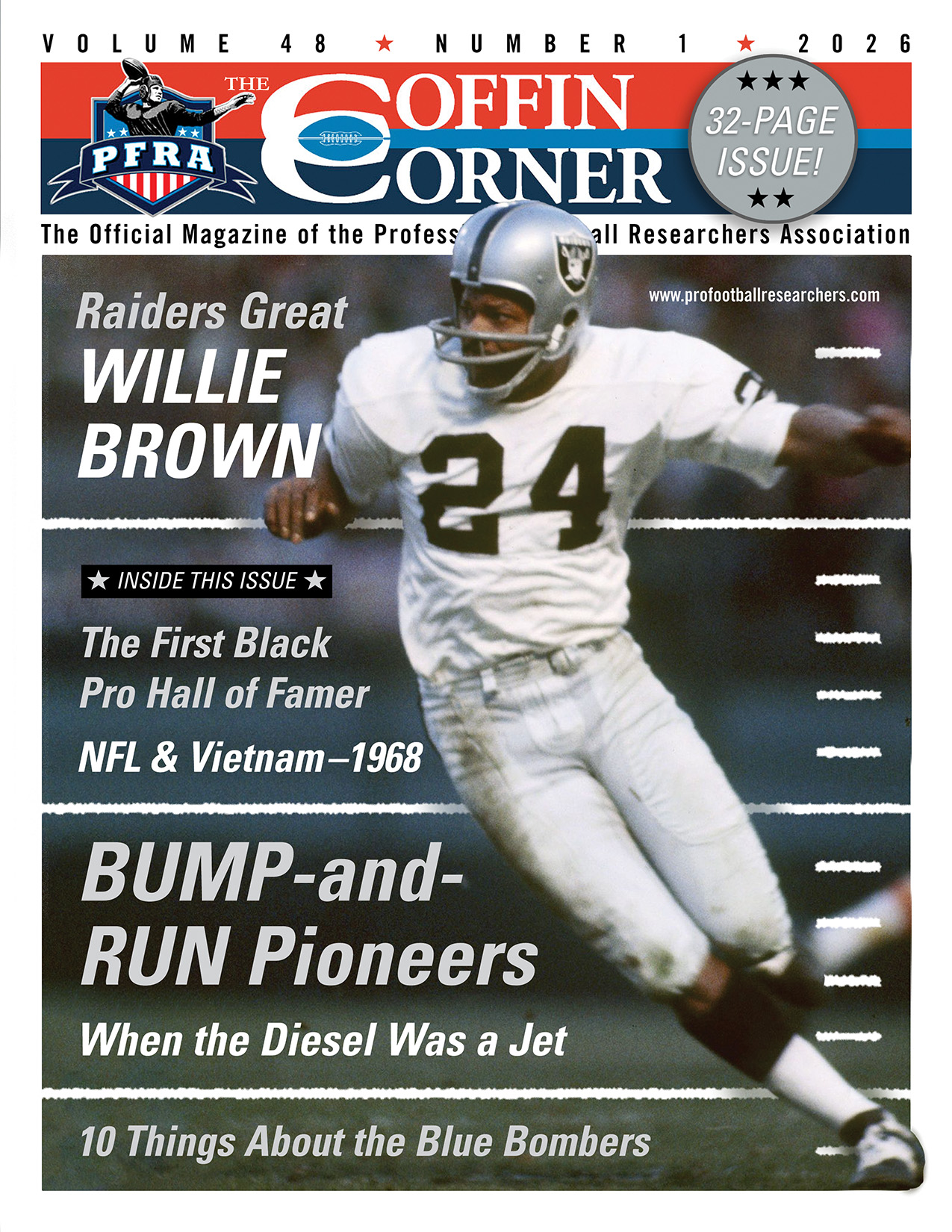
PFRA-ternizing An announcement of the new 32-page format, a historical marker commemorating the first pro football night game in Elmira, New York; and media appearances by PFRA President George Bozeka on the new 1964 Buffalo Bills book. Organizational updates are also included such as the 2025 election results, a new mailing address, a list of the latest Hall of Very Good inductees, and a call to contribute to the PFRA’s team pages.
The Pioneers of the Bump-and-Run by Jim Marino. An extensive history of the origins of the “bump-and-run” tactic in pro football and its evolution from pressing basketball defenses, first translated in the late 1950s through future Boston Celtic K. C. Jones to football coach Jack Faulkner. Its culmination came in the AFL during the 1960s with cornerback Willie Brown—and the Oakland Raiders under Al Davis—where it became a physical man-to-man type of coverage that was used as a defensive football strategy.
The First Black Pro Football Hall of Famer Played in Canada by Ryan C. Christiansen. A short biography of backfielder and Ohio native Tom Casey, who became the first African American inducted into any pro football hall of fame, entering the Canadian version in 1964. After a brief stint with the AAFC’s New York Yankees, Casey found a home with the Winnipeg Blue Bombers of the 1950s, where he became a multi-position star and later a neurologist after retiring from football.
The NFL, the USO, and the Tet Offensive—1968 by Marc R. Henderson, Ph.D. A recounting of a 1968 USO goodwill tour in which five NFL and AFL stars traveled to Southeast Asia to support U.S. troops, only to arrive in Saigon on the eve of the Tet Offensive and find themselves amid active combat. Despite the danger, the players continued visiting hospitals, bases, and outposts, turning a planned morale-boosting trip into a rare, firsthand encounter of the war in Vietnam that highlighted the broader cultural role of professional athletes during times of national conflict.
Back When the Diesel was a Jet by Mike Richman. This story runs through the highlights of John Riggins’ Hall of Fame career, and while he may be best remembered as a Redskins icon—punctuated by his legendary Super Bowl XVII run—he first established himself with the New York Jets as a talented and eccentric star. After a key free-agent move to Washington and a mid-career resurgence under Joe Gibbs, “Riggo” became one of the most durable and productive power runners in NFL history.
Ten Things You Probably Don’t Know About the Winnipeg Blue Bombers by John Horn. A 95-year highlight reel of the CFL team lovingly known as the ’Pegs: born out of necessity, nicknamed by a clever headline, coached by future NFL royalty, and periodically shipped to the Eastern Division like Canada’s most polite problem-solver. Along the way, the team played Grey Cups in mud, fog, wind, overtime, and apparently every possible weather disaster—usually against Hamilton—while never, ever figuring out how to beat Toronto. Toss in a few forgotten superstars, a stadium built because one quarterback threw too many exciting passes, and you’ve got this trivial treat that’s equal parts football, folklore, and frozen chaos.
Number 2:
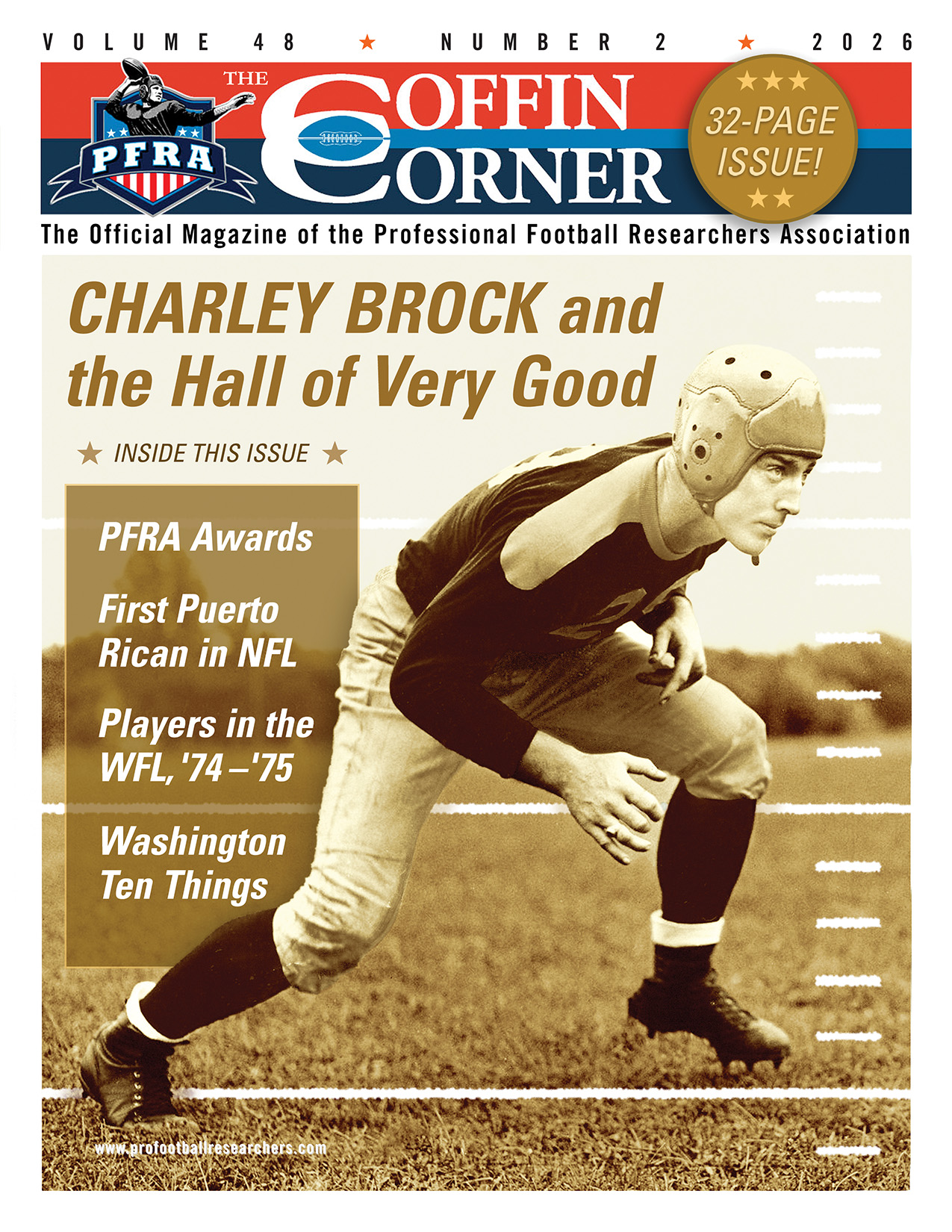
PFRA-ternizing Executive Director Lee Elder presents his annual “State of the PFRA” report to members and discusses the financial stability of the organization with continued growth, steady membership, increasing convention attendance, and expanding projects like The Coffin Corner and book series. The PFRA has also boosted its research output and social media presence, with plans to expand further with a YouTube presence. Reminders about Hall of Very Good nominations and membership renewals are also included.
2025 PFRA Awardshe official announcement of the Ralph Hay Award for lifetime achievement in pro football research and historiography, the Nelson Ross Award for recent achievement in pro football history, the Bob Carroll Memorial Writing Award for the best Coffin Corner article, and the Jack Clary Award for service to the organization.
The Hall of Very Good Class of 2025 by Jim Campbell, Matthew Keddie, Jeff Miller, Matt Reaser, Jay Thomas and John Turney. Career highlights of last year's class are listed for Jim Bakken, Charley Brock, George Christensen, Clem Daniels, Chris Hinton, Kent Hull, Greg Lloyd, Wilber Marshall, Nate Newton and Mike Stratton. Vote totals for all 2025 candidates are also included.
Dan Rosado: The First Puerto Rican to Start in the NFL by Mary Rosado. An intimate look at the inspiring story of a man who overcame long odds—returning to football after years in a blue-collar job—to become a starting center for the San Diego Chargers and one of the first players of full Puerto Rican descent to start in the league. This biography highlights both his perseverance and cultural impact, showing how his journey helped pave the way for greater Latino representation in pro football while emphasizing the pride in his heritage and his determination to achieve a dream.
The WFL, 1974–1975: Youngsters and Vets Looking for One Last Chance by Sean M. Miskimins. A spotlight on several players in the short-lived World Football League, overlooked rookies and former NFL players that were given a chance to showcase their talents, who often produced strong offensive performances and career revivals. Although the league folded after falling just short of two full seasons due to financial issues, the WFL served as the final opportunity for some, highlighting both unexpected success stories and missed opportunities.
2025 Player Deaths A list of the pro football players who died last year, including information on the team(s) and league(s) they played for, the date and location of their death (if known) and their age when they passed away.
Ten Things You Probably Don’t Know About the Washington Redskins/Commanders by Mike Richman. Ten fun facts of a football franchise that has had four nicknames in its existence and borrowed the first two from Boston baseball clubs, with the second one from a coach‘s questionable backstory, or possibly a silent film—all courtesy of original owner George Preston Marshall. Along the way, the team has had everything from a quarterback who earned a Ph.D. in the realities of higher mathematics to a player named after rotten fish, to Don Meredith casually roasting President Nixon on live TV during one of its games—proving that pro football in the nation’s capital has always been just as entertaining off the field as on it.
Number 3:
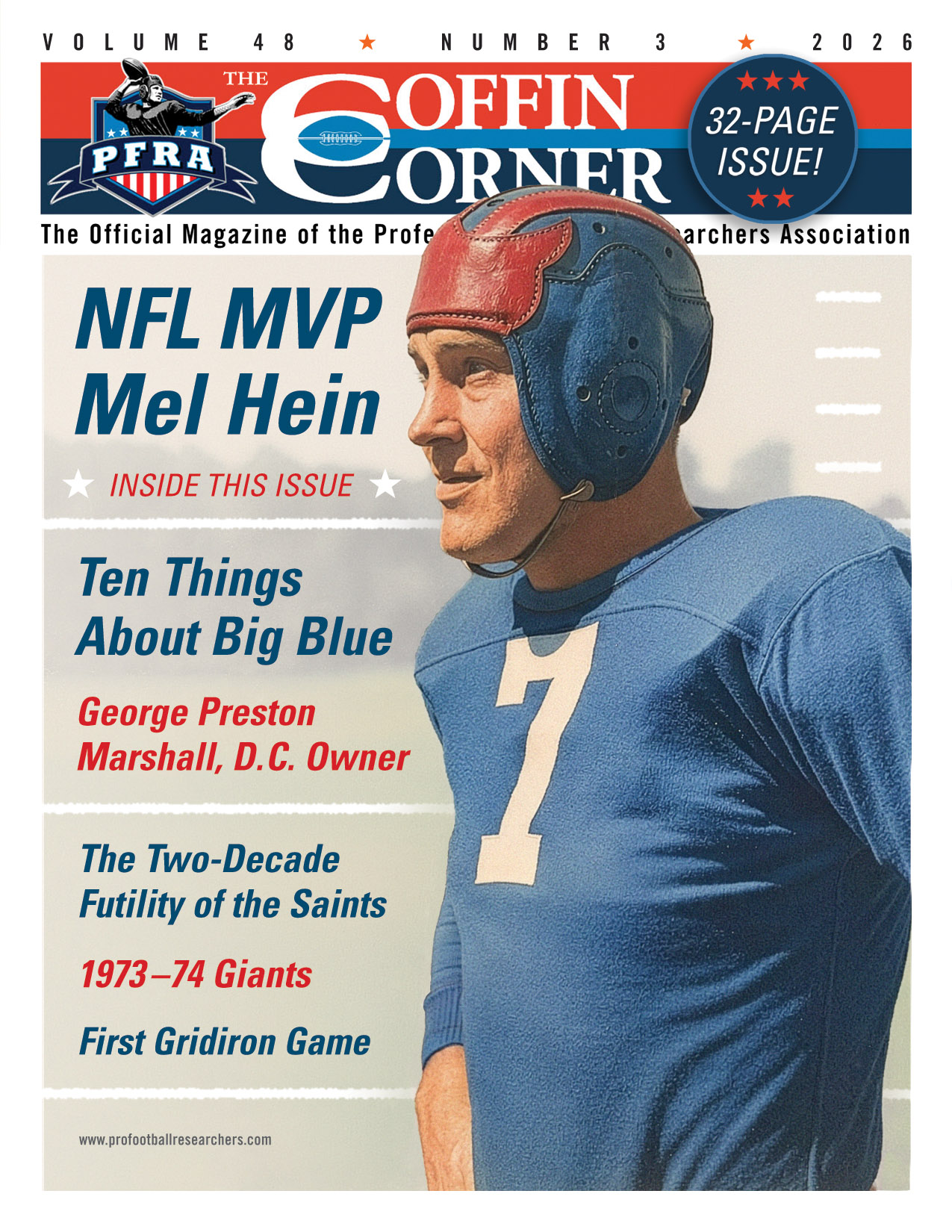
PFRA-ternizing Announcements on the newest book in the Great Teams series, the proposed PFRA YouTube channel, chapter news including the Tenth Annual Conference of the Western New York chapter, the upcoming Washington, D. C./Baltimore meeting on June 20 and the creation of new chapters in Dallas and Florida.
George Preston Marshall: The Flamboyant, Controversial Owner Left a Lasting Impact on the NFL by Mike Richman. A short biography of the longtime Washington owner who helped shape the modern NFL through innovative rule changes, marketing, and broadcasting that made pro football more popular and profitable. However, his legacy was overshadowed by lingering racism, including leading the NFL’s exclusion of Black players, becoming the last owner to integrate under U. S. government pressure in 1961, leaving Marshall remembered as both a pioneer and one of the league’s problematic figures.
It Wasn’t That Bad by William J. Ryczek. An author’s remembrance of two seasons of the New York Giants (1973–74) who finished on a downtrend but were viewed more positively by fans due to new coach Bill Arnsparger, quarterback Craig Morton, and several young players who gave the team hope and made 1974 far more competitive and exciting. The Giants lost several dramatic games in heartbreaking fashion, but their improved play suggested the franchise was finally moving in the right direction after the demoralizing collapse of 1973.
Two Decades of Futility: The 1967–1986 New Orleans Saints by Sean M. Miskimins. Twenty years of frustration for the ’Aints, who struggled early because of poor drafting and inconsistent leadership from a succession of general managers who repeatedly missed on talent, let good players leave, and failed to build a strong roster around quarterback Archie Manning. The franchise finally started to turn the corner in the 1980s under Bum Phillips, whose successful drafting and personnel decisions laid the foundation for New Orleans’ first winning season and finally a playoff appearance in 1987 led by Jim Mora Sr.
Ten Things You Probably Don’t Know About the New York Giants by Dan Neumann. A small taste of Big Blue tidbits for a team that spent a century collecting oddball stories: they’ve played home games in three states, briefly employed an aging Jim Thorpe for just a few half-games, survived a family feud so intense that buying light bulbs required diplomacy, and nearly turned into the “New Jersey Broncos” under Dan Reeves. Along the way they won their way to Super Bowls with fake punts, almost rehired the Big Tuna, and somehow became the only franchise to win championships on all four major TV networks—proving that their history is equal parts football dynasty, sitcom, and traveling circus.
The First Gridiron Game by Bert Gambini. A challenge to the traditional belief that the first intercollegiate football game was played between Rutgers and Princeton in 1869 and an argument that the contest was essentially a soccer-style match rather than true gridiron football. The contention here is that football as we know it began on October 16, 1880, when Rutgers and Stevens Institute met on the field under rules that introduced the line of scrimmage and defined possessions, innovations identified as the sport’s most fundamental characteristics.
Number 4:
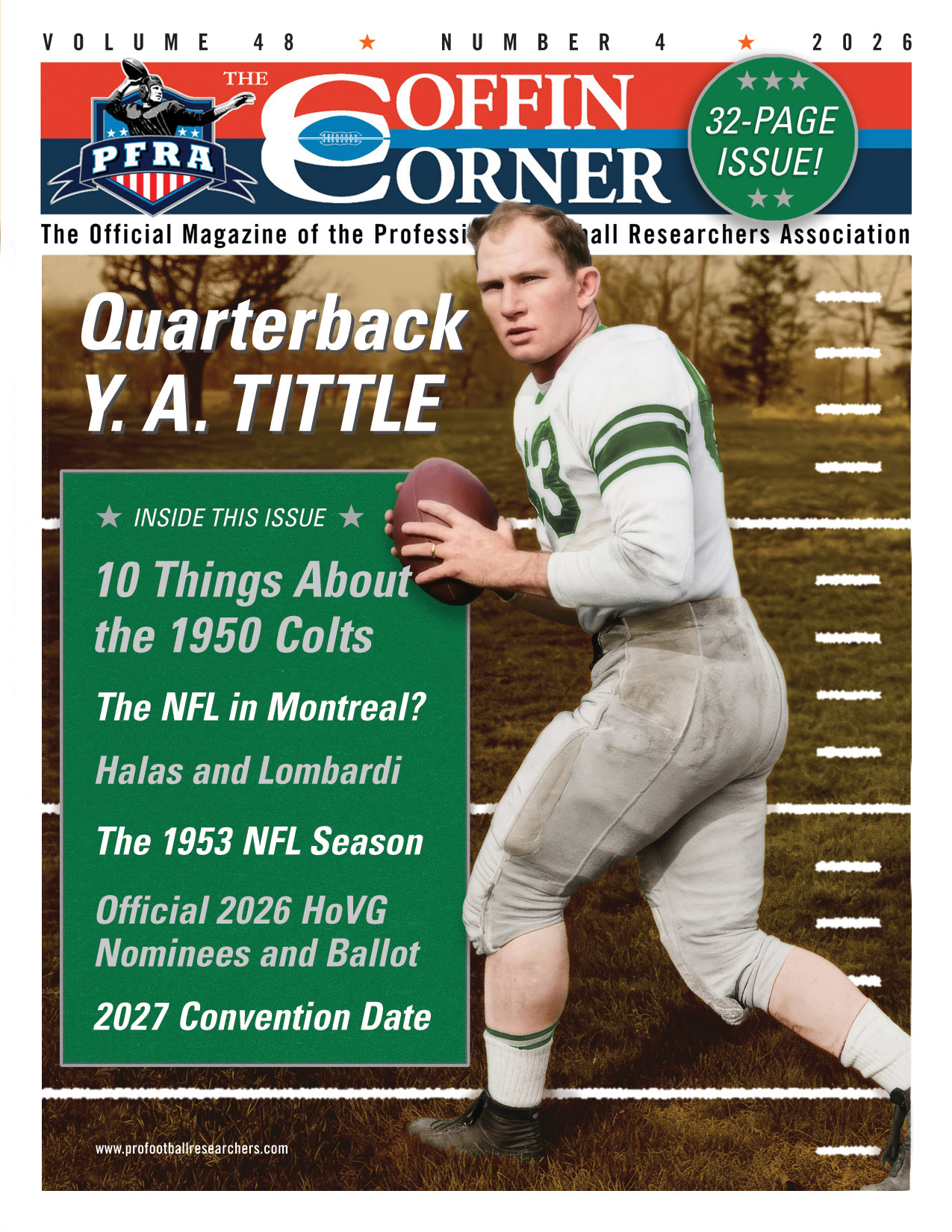
PFRA-ternizing An announcement about the date and location for next year’s PFRA convention, a call to members for material for the Members Only section, the release of three new episodes of the PFRA podcast, and updates on local chapters.
2026 Hall of Very Good Finalists by Matthew Keddie and Jay Thomas. From Joe “Doc” Alexander to Rick Upchurch, all 20 candidates for the 2026 Hall of Very Good class are listed alphabetically along with a mini biography for each.
Official 2026 Hall of Very Good Ballot NOTE: The deadline for voting is November 30, 2026.
Laying a ‘Football-Sized Egg’: Montreal and Its Failed 1969 NFL Bid by Chad Moody. In 1969, some members of a group that brought both the Expos and the Olympics to Canada hosted two NFL preseason games to gauge support for luring a team up north and also to encourage construction of a larger stadium, but poor attendance and lackluster fan support ended those ambitions. The Expos later moved into Olympic Stadium in 1977 and while the city hosted the occasional NFL exhibition, the longed-for dream of a franchise never materialized.
Halas & Lombardi by Charles Billington. An examination of the rivalry between two coaching legends that relays how Vince Lombardi’s Packers largely dominated George Halas and his Bears from 1959–1967, symbolizing the transition from the NFL’s old guard to a more modern era. Lombardi’s adaptability, innovative leadership, and progressive approach to managing players contrasted with Halas’s increasingly outdated methods, explaining why Lombardi emerged as the more successful coach during the Sixties.
Ten Things You Probably Don’t Know About the 1950 Baltimore Colts by Ben Carpenter. The original Colts were so spectacularly bad that they only won a single game (more on that later), gave up points like they were handing out Halloween candy, and folded after just one season in the NFL—making even their own players shrug at the club's demise. Their lone shining achievement was somehow producing multiple Hall of Famers (Y. A. Tittle, George Blanda, and Art Donovan) along with one of the strangest comebacks in NFL history, proving that even football disasters can be overachievers.
1953: One of the Most Exciting Seasons in Pro Football by Ryan “R. C." Christiansen. Speaking of comebacks, 1953 was one of the most thrilling NFL years on record, featuring an unusually high number of fourth-quarter comebacks led by quarterbacks like Jim Finks of the Steelers and Eddie LeBaron of the Redskins. The season ended on December 27 with yet another dramatic rally, as Bobby Layne led the Detroit Lions to a come-from-behind victory over the Cleveland Browns in the NFL Championship Game.